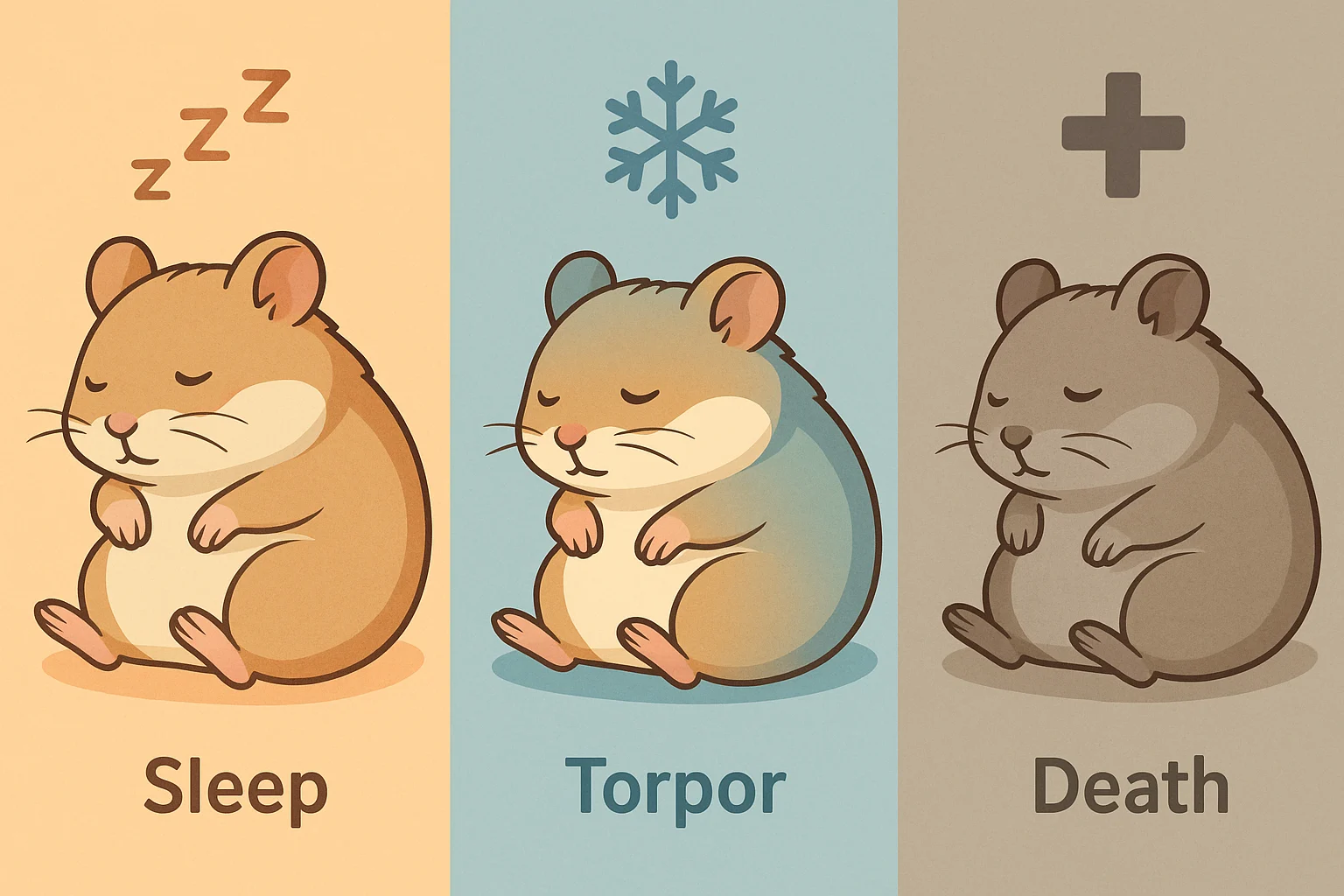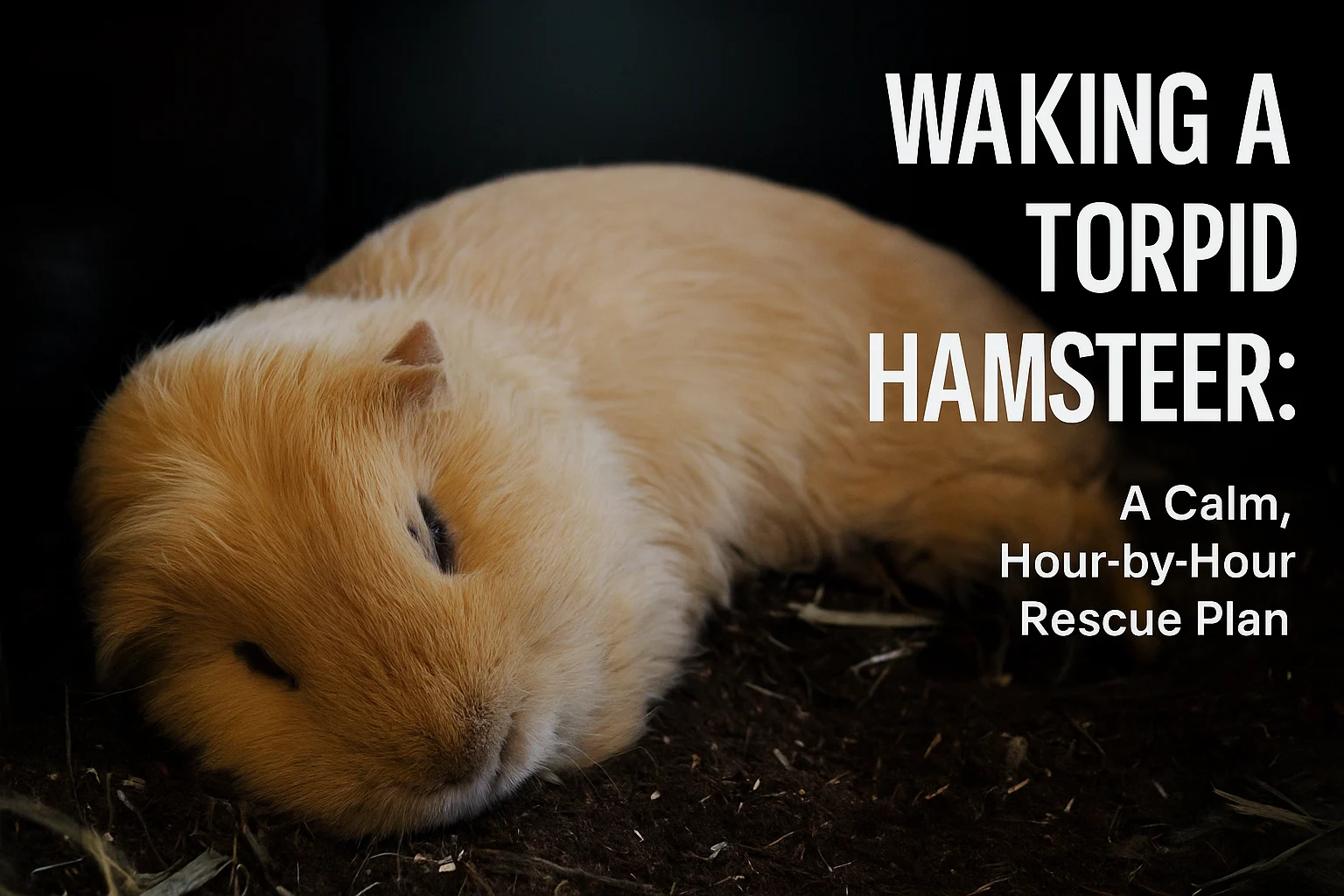



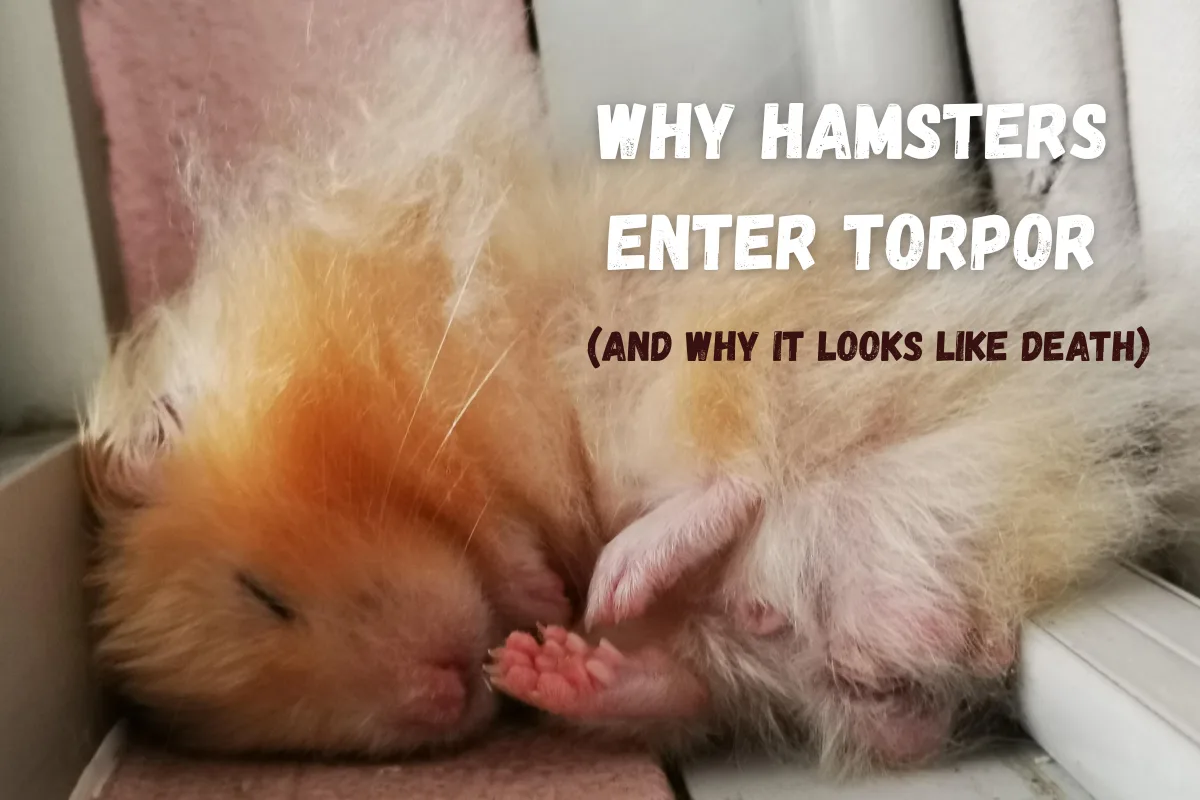
When a hamster’s environment suddenly screams “deep winter,” its body may flip a built-in circuit breaker known as torpor. Think of it as a pocket-sized version of hibernation—the same energy-saving strategy, but condensed into a matter of hours or days instead of weeks or months.
What Exactly Is Torpor?
Torpor is a short-term, involuntary shutdown of vital systems, triggered by environmental stress, not by seasonal instinct like true hibernation.
Definition: Torpor is marked by a dramatic drop in core temperature, heart rate, and metabolism. Scientists generally classify it when core body temperature falls below 32°C (89.6°F) for at least 30 minutes.
Duration: A torpor episode typically lasts anywhere from 6 hours to a few days, depending on how long the stressful conditions persist. Unlike full hibernation, it ends as soon as warmth or food returns.
Which hamsters experience it? Syrian (golden) hamsters are the most torpor-prone, but dwarf species—like Djungarian or desert hamsters—can enter brief or shallow torpor during food shortages or cold snaps.
(Sources: PetMD, PMC, ScienceDirect)
Why Evolution Kept the Switch
Torpor isn’t a bug in the system—it’s an elegant solution to survival on a small body budget. Here’s why nature kept this energy-saving tool in the hamster playbook:
- Energy Triage for Tiny Bodies
Small mammals like hamsters burn calories at lightning speed just to maintain body heat. By lowering their internal thermostat by 20–40°C, they can slash their energy use by up to 70%.
- Built-In Backup for Harsh Winters
In the wild, winter means food vanishes and temperatures nosedive. Without torpor, a hamster might burn through its fat reserves before spring. This adaptive pause helps it outlast short-term crises, like a surprise frost or seed shortage.
- Flexible > Committed
Unlike hibernation, torpor is reversible and responsive. If food suddenly appears or danger strikes, a torpid hamster can snap back to full alertness far faster than a hibernator deep in seasonal slumber. This flexibility is a major survival advantage, especially for prey animals.
Source: Journal of Experimental Biology, NC3Rs.org.uk
What Pushes a Pet Hamster Into Torpor?
Torpor isn’t random—it’s a biological SOS triggered by the environment. Below are the main cues that can send your hamster into this energy-saving state:
| Environmental Cue | How It Signals “Energy Crisis” |
|---|---|
| Cold below ≈ 65°F (18°C) | Core heat drains faster than your hamster can replace it. To avoid hypothermia, their metabolism shuts down to conserve warmth. |
| Short daylight (< 8–10 hrs) | A shrinking light cycle tells many rodents that winter—and its food shortages—are coming. This shift can trigger torpor, especially in combination with cold. |
| Food or water shortage | When nutrients are limited, torpor kicks in to preserve what little energy is left—cutting the metabolic rate by up to two-thirds. |
| Sudden temperature drops | Rapid environmental changes—like an open window or a cold draft—can shock the body’s thermostat and force a shutdown. |
| Stress or illness (secondary) | On their own, stress or disease don’t cause torpor—but they can weaken the hamster’s resilience, making them more vulnerable when other conditions hit. |
Bottom line: Torpor is rarely caused by just one thing—it’s the result of environmental strain stacking up, often starting with cold.
The Inside Story: What Changes (and How Fast)
When a hamster enters torpor, its body doesn’t just slow down—it overhauls nearly every vital function to conserve precious energy. These shifts happen quickly, sometimes within minutes of exposure to cold or stress, and are so extreme that they can easily be mistaken for death.
Here’s a look at the most dramatic changes happening behind the scenes:
1) Core Body Temperature
A healthy hamster runs warm, between 98–102°F (37–39°C). In torpor, that drops into the low 60s°F (around 16°C) or lower. The colder they get (within safe limits), the more energy they save on heat production.
2) Heart Rate
From a brisk 250–400 beats per minute, the heart rate can plummet to just 3–20 beats per minute during torpor. This ultra-slow rhythm conserves both oxygen and fuel—but makes any heartbeat almost impossible to detect by touch.
3) Breathing Rate
Typical breathing ranges from 35–135 breaths per minute in an active hamster. In torpor, it may drop to just 1 or 2 breaths per minute, with 30–60 seconds between each one. This can make your hamster seem not only still—but completely lifeless.
4) Metabolic Rate
At rest, a hamster runs at full energy-processing capacity. In torpor, the metabolic rate can fall to 30–50% of normal. Key enzymes in the liver, heart, and brown fat are essentially “dialed down,” drastically reducing the breakdown of glucose and other fuels.
5) Posture and Appearance
Behaviorally, torpid hamsters go from busy explorers to tight, coiled balls with half-closed eyes and limp bodies. This curled posture helps minimize exposed surface area, conserving heat just like a tightly folded blanket.
Source: The Hamster Forum
Torpor vs. True Hibernation—At a Glance
While torpor and hibernation may look similar on the surface, they’re distinct biological processes with different durations, triggers, and risks—especially in captivity. Here’s how they compare:
| Feature | Torpor | True Hibernation |
|---|---|---|
| Length | Lasts hours to a few days | Lasts weeks to months |
| Trigger | Activated by immediate environmental stresslike cold, food scarcity, or short daylight | Governed by an internal seasonal clock—usually tied to photoperiod and hormones |
| Wake-up Pattern | Spontaneous—hamster revives when conditions improve | Occurs on a fixed cycle, with planned arousals every 1–2 weeks to rehydrate and reset physiology |
| Rodent Examples | Common in hamsters, mice, and some squirrels(short-term only) | Seen in ground squirrels, marmots, and other true hibernators |
| Captive Risk Level | High—if unnoticed, can lead to dehydration, hypothermia, or death | Rare—pet hamsters don’t hibernate, and hibernators aren’t common pets |
Bottom line: Torpor is your hamster’s emergency “power-save mode.” Hibernation is a long-haul seasonal strategy most domestic pets never use.
Why Owners Mistake Torpor for Death
It’s one of the most heart-stopping moments in hamster ownership: you find your pet cold, still, and unresponsive. But before assuming the worst, it’s important to understand why torpor looks so much like death—and how you can tell the difference.
Skin is cool, body is limp.
During torpor, blood flow is redirected to the hamster’s core organs to preserve vital function. This makes the limbs feel cold and floppy, mimicking a lifeless body.
Breaths and pulses are nearly undetectable.
Your hamster might only breathe once every 30–60 seconds, and its pulse can slow to a faint flutter. These signs are so subtle that they’re easy to miss, especially in a moment of panic.
Eyes may stay open.
Torpor often leaves the eyes half-open or unblinking, which can appear unsettlingly lifeless, even though the hamster may still be alive.
Real rigor mortis takes time.
A key clue is limb flexibility. A torpid hamster stays soft and bendable, while a deceased one will begin to stiffen a few hours after passing.
Tip: Take a calm, two-minute exam. Use a flashlight to check for the faintest chest rise or whisker twitch. Gently move a leg to test for resistance. These small but crucial signs can confirm that your hamster is in torpor, not gone.