



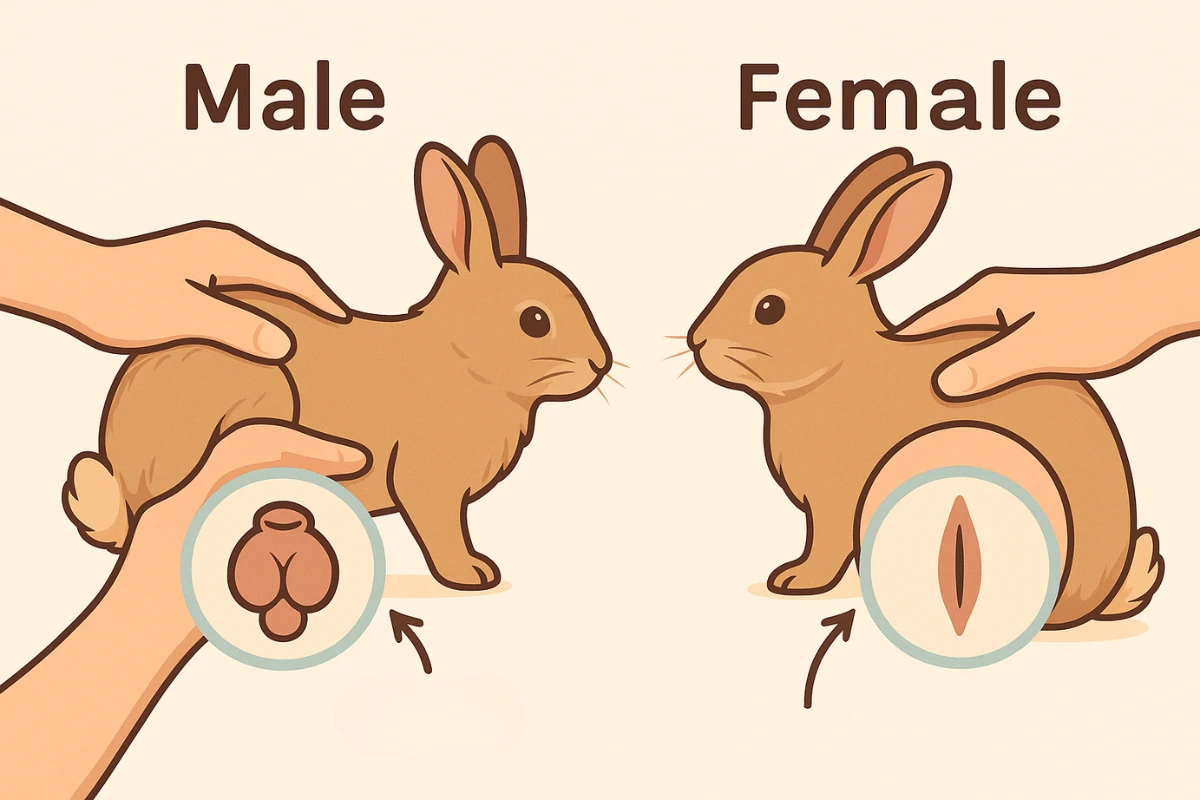
Baby rabbits don’t develop obvious external sex characteristics until they’re a bit older. Unlike puppies or kittens, a rabbit’s genitals are tucked inside and can look almost identical across sexes during the early weeks of life. That’s why even breeders and pet stores occasionally get it wrong when labeling a rabbit’s gender.
Yet, correctly sexing your rabbit is more important than it might seem—especially early on. Knowing whether your bunny is a buck (male) or a doe (female) matters for a few key reasons:
- Preventing surprise litters: Rabbits can start breeding as early as 3–4 months old!
- Safely bonding pairs: Same-sex pairs tend to get along better unless both are fixed.
- Planning vet care: Spaying and neutering timelines differ slightly between bucks and does.
Below is a step-by-step guide that rabbit-savvy vets often use, including realistic age windows for accurate sexing, common mistakes to watch for, and what to do if you’re still unsure.
When Can You Tell the Gender of a Baby Rabbit?
You can start checking around 5 weeks, but the most reliable window is between 8–12 weeks. Before that, the genitalia are too small and similar to be consistently accurate. After 12 weeks, differences become clearer—and more urgent if you’re trying to separate potential breeders.
Age Guide for Sexing Rabbits
| Age | What You’ll See | Reliability |
|---|---|---|
| 0–2 weeks | Translucent skin, almost no difference between sexes | Nearly impossible |
| 3–5 weeks | Hints of a “tube” (male) or “slit” (female), but not reliable | ~50/50 at best |
| 6–8 weeks | Shapes more defined, but testicles haven’t descended | ~70% with practice |
| 10–12 weeks | Testicles visible in males, slit more distinct in females | ~95% reliable |
| 4 months+ | Clear behavior differences (spraying, mounting, nesting) | 100%—but possibly too late |
✅ Tip: Double-check your bunny’s sex around 8 weeks and confirm again by 12 weeks to avoid surprises.
How to Sex a Rabbit: The Vent-Check Method
The most accurate way to determine your rabbit’s sex—especially between 6 and 12 weeks of age—is by using a technique called vent sexing. This method involves gently exposing the genital opening (vent) and observing its shape and position. With a little practice, it only takes about a minute.
🐰 Step-by-Step Guide
1. Get your rabbit into position.
Place your bunny on a non-slip surface like a towel on a low table. Gently support their back end so they’re upright—but avoid flipping them onto their back, which can cause stress or breathing issues. If needed, ask a second person to help steady them.
2. Locate the vent area.
Part the fur between the hind legs. Start by identifying the anus, which sits closest to the tail. Just in front of it lies the genital vent, often slightly hidden under soft fur.
3. Gently expose the vent.
Use your thumb and forefinger to press downward on the area just above the genital opening. This will cause the tissue to protrude slightly, giving you a clear look.
4. Read the shape.
This is the most important step:
- If you see a pink, round “donut”-shaped opening or a tube-like button pop up, you’re likely looking at a male (buck).
- If the tissue remains flat and shows a vertical slit that runs nearly flush with the anus, your rabbit is a female (doe).
5. Look at the spacing.
In males, there is usually a slightly larger gap between the anus and the genital opening. In females, the two openings are very close together, sometimes almost touching.
6. Feel for bulges (if 10+ weeks old).
At around 10 to 12 weeks, male rabbits’ testicles descend, forming small, smooth sacs on either side of the penis. These may retract if the rabbit is cold or scared, so don’t panic if they’re not visible.
7. Gently release your bunny.
As soon as you’ve gotten a clear look, let your rabbit return to a natural position. Keep the whole process under 30 seconds, and offer a treat afterward to make the experience more positive.
🐾 Tip: Compare two kits side by side. It’s often much easier to notice the difference when you have both a male and a female to compare.
Still Not Sure? Try These Troubleshooting Tips:
- Wait a few days. A rabbit’s sex can become clearer even within a week as they grow.
- Use a zoomed-in photo. Snap a close-up and examine it on your phone—it’s often easier than checking a squirming bunny.
- Ask your vet. A rabbit-savvy vet can identify sex quickly and confirm your findings if you’re unsure.
Sources: bosworthbunnies.weebly.com | homeandroost.co.uk | rabbitwelfare.co.uk
What Changes As They Grow?
As baby rabbits mature, their physical and behavioral signs become more distinct:
Males (Bucks)
- Testicles drop around 10–12 weeks, forming visible sacs
- Scent marking and spraying often begin around this time
- Mounting, circling, and honking may appear by 3–4 months
Females (Does)
- No testicles; the area beside the vent stays flat
- Some breeds develop a dewlap (neck fold) after puberty
- Nesting behavior, like hay carrying, may begin around 4 months
⚠️ Reminder: Behavior overlaps. Always rely on anatomy first, behavior second.
What to Do After the Gender Reveal
Once you’ve confirmed your rabbit’s sex, the next step is planning ahead—especially if you have more than one rabbit or want to avoid unplanned litters.
At 6–8 weeks, it’s important to separate males and females. Even though they’re still young, rabbits can become fertile earlier than expected. Some bucks have been known to breed successfully before 12 weeks, so it’s safest to split them once their gender is known.
By 10–12 weeks, most male rabbits will have visible, descended testicles, making them eligible for neutering. This procedure helps prevent hormone-driven behaviors like spraying, mounting, and aggression—and it also eliminates the risk of future fertility.
(rabbitwelfare.co.uk)
For females, spaying is typically recommended between 4 and 6 months of age. This gives time for the uterus to grow large enough for the vet to perform surgery safely. Spaying also offers long-term health benefits, especially by preventing uterine cancer, which is common in unspayed does.
After surgery, it’s crucial to keep newly neutered males away from unspayed females for up to six weeks. Even though they’ve been castrated, residual sperm can remain active for a while—meaning an accidental litter is still possible during this time.
Common Mistakes & Myths
Sexing baby rabbits is tricky—even for professionals. Here are some common myths and misunderstandings that trip up new owners:
“The pet shop already sexed them.”
Don’t take it at face value. Misidentifying baby rabbits is incredibly common, even among breeders, pet stores, and sometimes newer vets. Always double-check at home, especially before the crucial 12-week mark. (rabbit.org)
“Mounting means he’s a boy.”
Not necessarily. Both bucks and does mount as a show of dominance. It’s more about social hierarchy than gender.
“Testicles are always visible once they drop.”
Not quite. While testicles typically descend by 10–12 weeks, bucks can retract them into the abdomen when stressed, scared, or cold. It’s normal if they seem to “disappear” temporarily.
“It’s cruel to handle babies.”
When done calmly and gently, a brief check is not harmful. In fact, it’s much safer in the long run than risking an accidental pregnancy.
Real-Life Example: Bunny Gender Reveals
In the video examples, we can see how the process works in action:
- Vanilla: When examined, Vanilla displayed a circular opening with a dot in the center, indicating it’s a boy. This is the most common sign for male rabbits.
- The Second Bunny: The second bunny had a vertical slit, a clear indicator of a female rabbit.
- Chocolate: Chocolate also showed a circular opening with a dot, confirming it was a male rabbit.
- Big Daddy: Finally, Big Daddy displayed a round opening with a dot, making it clear he’s a boy.
With these examples, you can see how each gender has distinct characteristics, and how with practice, it becomes easier to identify your bunny’s sex.
Final Thoughts
Sexing baby rabbits is a quick and gentle process once you know what to look for: a round protrusion versus a narrow slit, the spacing between openings, and—later on—the presence of descending testicles. The key is to check early, check twice, and stay ahead of the spay/neuter timeline.